Tarot with no belief or buy-in required.
Because the woo isn’t you.
- As seen in HuffPost’s 21 Nostalgic Gifts for Millennials
- Two 78-card decks, each with its own guidebook


- Do a reading. If it doesn’t land, send it back within 30 days.
Tarot is about timeless human patterns.
We wanted them to be easier to recognize.
I renamed and redrew all 78 cards, first for Millennials like me, then (with help) for Gen Z. I wanted each one to be:
- Instantly recognizable
- About our real struggles
- Light and self-aware, but able to go deep
Seven cards, three ways each. First the original Rider-Waite card from 1909, drawn in old symbols you have to look up. Then our two versions, which you just get, named the way you would say it. The original name is still printed on our cards.
- The Sun. The original: a naked child rides a white horse under a huge smiling sun, sunflowers behind him. Millennial Tarot: Insta-Famous, a woman in big sunglasses and a sun hat posing under a pink beach umbrella. Gen Z Tarot: Serving C, a model strutting down a city street in a swirling rainbow gown. Shining looks different now.
- The Tower. The original: lightning strikes a stone tower, its crown blows off and two people fall through the flames. Millennial Tarot: Dumpster Fire, a purple dumpster burning on a cracked road, smoke pouring into the sky. Gen Z Tarot: It's Giving Doomsday, someone walking a beach covered in trash toward a city on fire. Our disasters, named honestly.
- Two of Cups. The original: a young man and woman trade cups under a winged lion, making a promise. Millennial Tarot: Engagement Photos, two men leaning in forehead to forehead under a garden gazebo. Gen Z Tarot: Smash or Pass, two faces sizing each other up between an X and a heart. How we commit now.
- Queen of Wands. The original: a queen on a lion throne holds a sunflower and a staff, a black cat at her feet. Millennial Tarot: Baddie, a woman in a red coat and helmet sitting on her motorcycle, unbothered. Gen Z Tarot: Iconic, a pop star in a sparkling bodysuit singing under stage lights to a roaring crowd. What confidence means in our culture.
- Four of Swords. The original: a knight lies still on a tomb under a stained-glass window, three swords hung above him. Millennial Tarot: Self-Care, a jade face roller, a jar of cream and one calm, made-up eye. Gen Z Tarot: Protecting My Peace, someone in a bubble bath with a face mask, candles and a rubber duck. Rest is our modern ritual.
- King of Swords. The original: a stern king sits on his throne with his sword raised. Millennial Tarot: Grown-Ass Man, a calm man with his eyes lowered, holding an armful of houseplants. Gen Z Tarot: Short King, a man in a suit holding an umbrella over his taller date in the rain. Lighthearted, still helpful.
- Queen of Swords. The original: a queen on a stone throne holds up a sword, her other hand open. Millennial Tarot: Independent Woman, a woman standing alone on a high platform above the clouds. Gen Z Tarot: Women in STEM, an astronaut looking up at the stars, lab glassware floating around her. The progress we’ve made.








A deck, a guidebook and a box worth keeping.
- 78 full-color cards, each named for what it means now
- A 132-page guidebook: TL;DR, The Sitch and Real Talk for every card
- A keepsake box that opens like a book and closes with a magnet
Shown with Gen Z Tarot, its other half in the bundle: its own 78 cards, 112-page guidebook and box.
Everything in the box, set out on a table. On the left, the Millennial Tarot keepsake box open like a book with its guidebook inside, the deck stacked in front, and three of its cards face up: Off-the-Grid, Swipe Right and The Millennial. On the right, the same for Gen Z Tarot, with CEO of Me Time, Green Flag and Glow Up. Around them, the everyday things they live with: a big black tumbler, car keys, earbuds, an iced latte and a claw clip.

One deck, the other,
or the pair for $11 off.
Most people end up with both — save $11 when you get both.
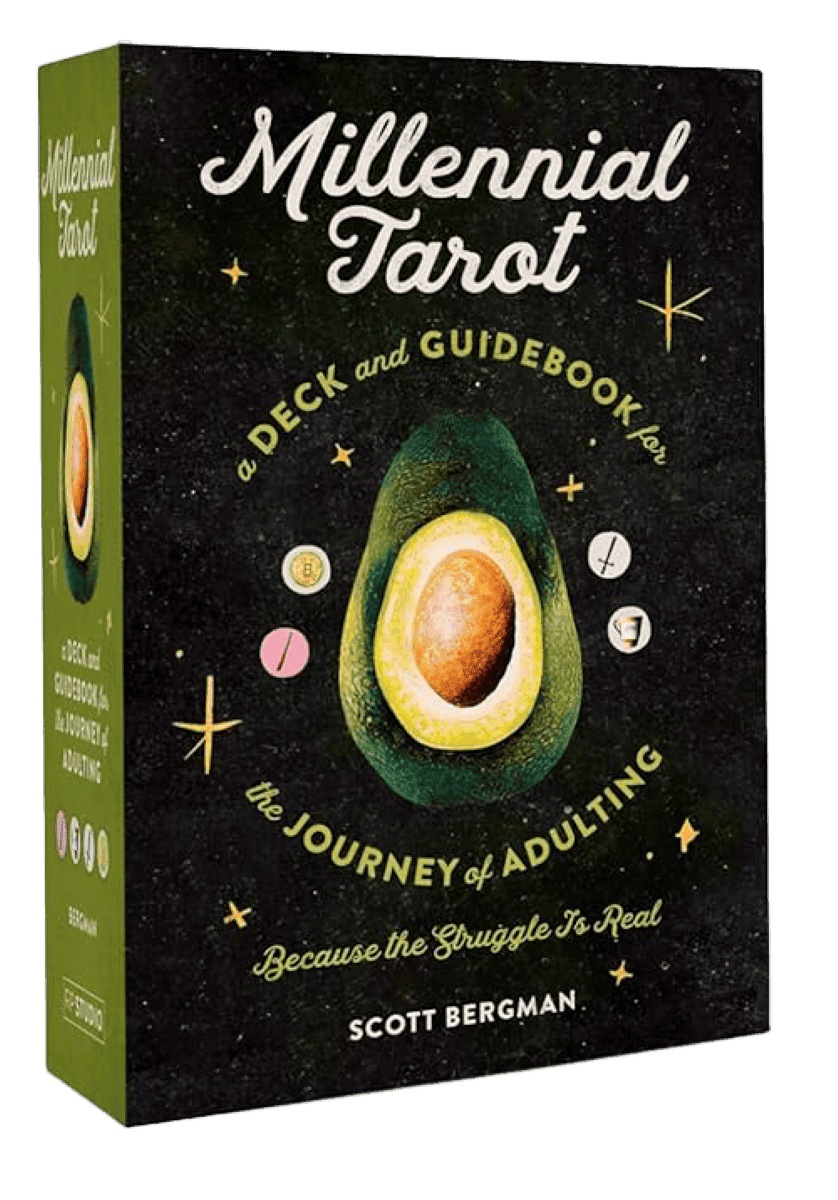
- ✦ Millennial Tarot — 78 cards + 132pp guidebook + keepsake box
- ✦ Free U.S. shipping
- ✦ Ships in 1–2 business days
- ✦ 30-day returns, no questions
- ✦ Millennial Tarot — 78 cards + 132pp guidebook + keepsake box
- ✦ Gen Z Tarot — 78 cards + 112pp guidebook + keepsake box
- ✦ Bundle discount applied — save $11 at checkout
- ✦ Free U.S. shipping
- ✦ Ships in 1–2 business days
- ✦ 30-day returns, no questions
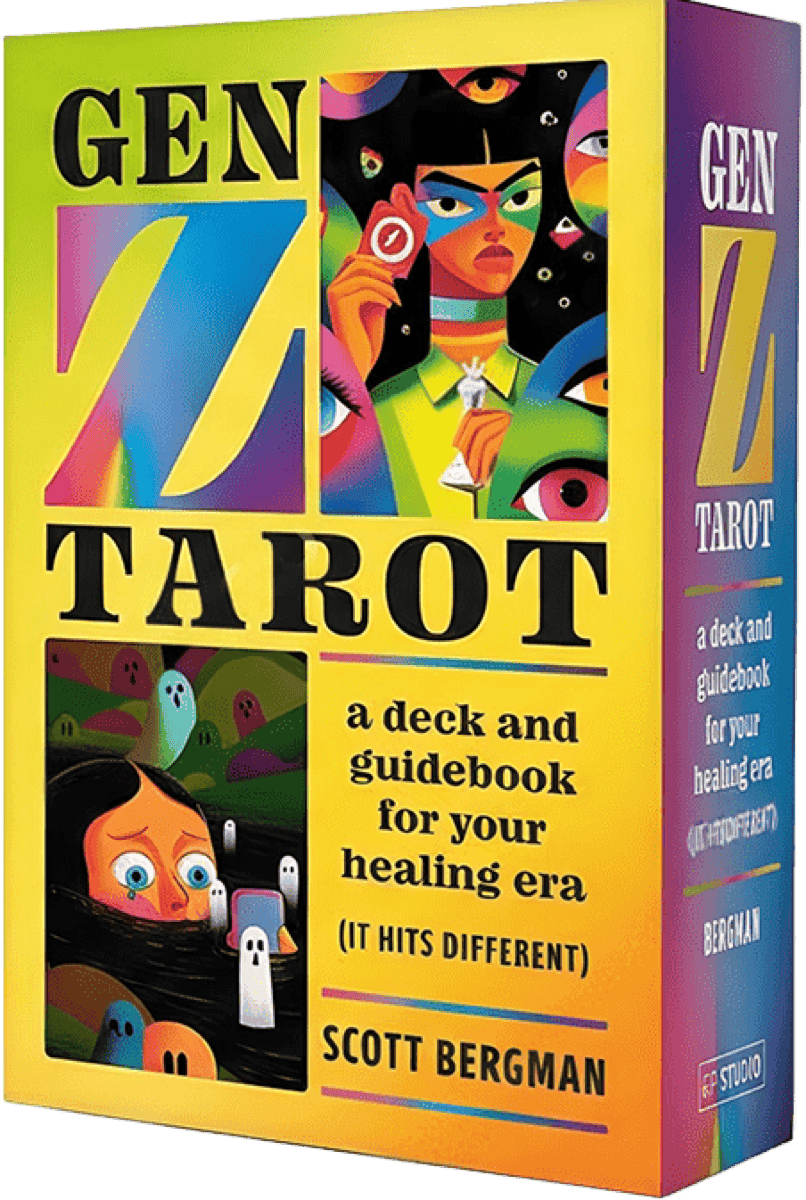
- ✦ Gen Z Tarot — 78 cards + 112pp guidebook + keepsake box
- ✦ Free U.S. shipping
- ✦ Ships in 1–2 business days
- ✦ 30-day returns, no questions


About the Creator
“Can wisdom be so accessible?”
Scott Bergman is a Millennial. He was a painter, then an Apple designer, lived in Buddhist monasteries, did van life and met his wife on Hinge. He still can’t buy a house. He wants to be happy, like everyone. Buddhism and psychology taught him a lot. Using it was the hard part: in the moment, recognizing which pattern you’re in and what wisdom applies. He wanted to make it easier without watering it down. Tarot already maps 78 of those patterns. His hope was to show each pattern the way we live it now, and make timeless wisdom so accessible to grasp.
Beside the story, photos from Scott's life, pinned up like a scrapbook. A gold-star 90s kid with red curls, grinning. Van life: the view out the back of his van onto a mountain lake at sunset. Buddhist training: Scott with a Tibetan Buddhist teacher in a temple, holding up a certificate. Met on Hinge: Scott and his wife Nicole laughing at their wedding. And Scott today, standing with his hands in his pockets.
Spiritual but not religious
In San Francisco I kept seeing the same thing in my generation: we’d moved away from traditional religion but hadn’t lost the desire. Burning Man, meditation apps, epiphanies at EDM shows, finding your tribe at CrossFit. Same timeless patterns and need for ritual and community, different characters, venues and lingo. Tarot held the same patterns; its old language just hid them.
The Gen Z deck
After a publishing deal, a Gen Z version felt obvious. I drafted cards myself, showed them to my wife Nicole’s Gen Z sister and her friends, and realized I was very, very off. Hailey Alt came on and everything unlocked: her timing and cultural ear, my structure and symbolism. Months of spreadsheets and re-votes later: 78 names, funny, sharp and still real tarot.
A family project
My great-grandfather started a printing business in New York. My dad printed the first Millennial Tarot decks himself, and during COVID my mom (aka “The Mothership”) shipped them from a spare bedroom. When demand outgrew the bedroom, Running Press, a Hachette imprint, took over.
